-

Centre for Dynamic Imaging

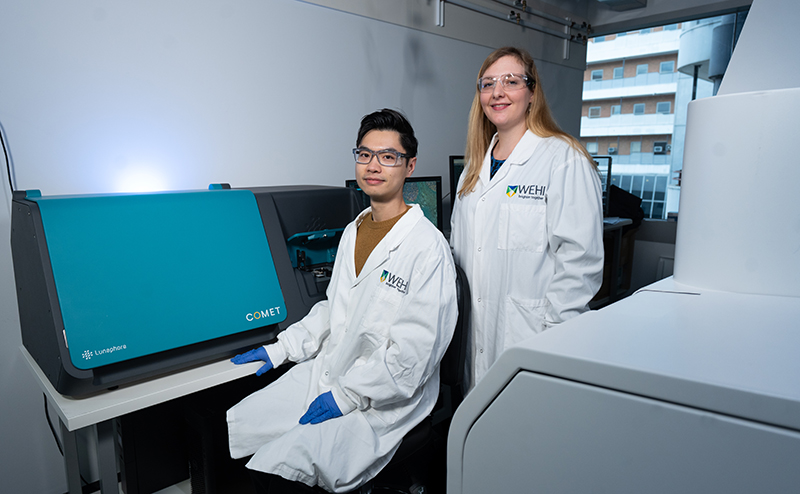
Lunaphore COMET

The COMET is a hyperplex spatial biology platform. Using an iterative cyclic imaging strategy, it allows the detection of up to 80 (protein) biomarkers in a single tissue section and a single protocol, preserving spatial context and tissue integrity.

The system uses standard unconjugated, off-the-shelf antibodies to deeply profile the tissue microenvironment, uncover cellular heterogeneity, and accelerate biomarker discovery.

In addition, the COMET allows for the simultaneous detection of up to 12 RNA targets in parallel with protein markers, enabling integrated spatial multi-omics analyses in the same sample.


Unique features

  • Visualises up to 80 protein targets in pure spatial proteomics
  • Enables spatial multi-omics imaging of up to 12 RNA targets, with a trade-off in protein detection capacity depending on the RNA panel size
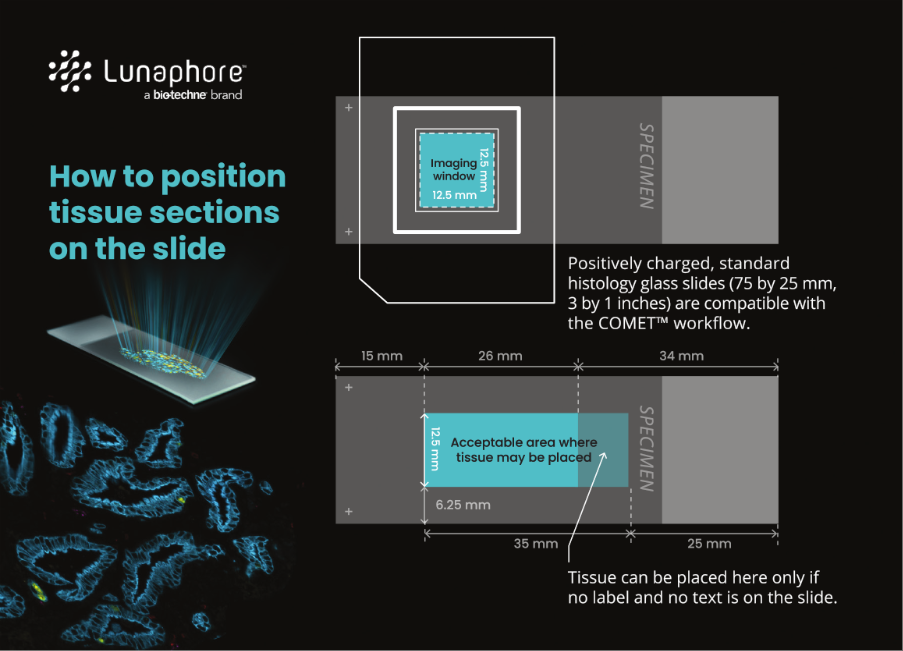
  • Imaging areas: 5.6 mm x 5.6 mm, 9.0 mm x 9.0 mm, 12.5 mm x 12.5 mm
  • Staining volume: 350ul per slide
  • Slide capacity: maximum 4 slides per run
  • Throughput:
    • 10-plex 30 slides a week
    • 20-plex 20 slides a week
    • 40-plex 12 slides a week
  • Channels: DAPI (432 ± 36 nm), FITC (527 ± 20 nm), TRITC (593 ± 40 nm), Cy5 (680 ± 42 nm), Cy7 (809 ± 81 nm)
  • 20X objective, 0.7 NA: theoretical XY resolution ~0.5-0.6 um
  • Image pixel size at 0.28 um
  • Widefield CMOS camera, offering broad dynamic range for pixel intensity (12-bit; 0–4095), stored in 16-bit format for analysis compatibility
  • Output format: OME-TIFF
  • Compatible with fresh/fixed frozen and FFPE tissue sections of various origins
  • Compatible with off-the-shelf antibodies and routine histological slides
  • Efficient antibody binding and gentle elution via pressurised micro-fluidic exchange
  • Possible upstream workflows e.g. Xenium and downstream workflows e.g. chromogenic staining H&E

Limitations

  • Tissue autofluorescence
  • Limited imaging area
  • An imaging chip is essential to form pressurised micro-fluidic chamber
  • Z-stack imaging not available for spatial proteomics

Sample preparation

  • Prepare tissue sections in 3-10 um thickness, mounted on positively charged slides e.g. a Superfrost Plus slide


Key experts

Contact us

Contact the Centre for Dynamic Imaging to book equipment or discuss imaging collaborations.